I went looking for the drug that wins. Everyone online seems to have picked a side, tirzepatide bros in one corner, semaglutide loyalists in the other, both convinced the other camp is either getting scammed or missing out. So I pulled the trial data, the FDA label, and the mechanism papers to settle it. What I found is that the “which is better” fight is mostly people shouting at each other from two different spreadsheets, and the actual story is somewhere else entirely.
The claim
The claim, repeated in every comment section, is some version of: tirzepatide is the stronger drug, full stop. Better numbers, better mechanism, semaglutide is basically the previous generation. It’s a tidy story. It also isn’t quite what the record says.
What the record actually shows
Here’s the one real difference, and it’s worth sitting with because everything else people argue about traces back to it. Semaglutide works on a single receptor, GLP-1 [P4]. Tirzepatide works on two: it’s a dual agonist hitting both GLP-1 and GIP, and structurally it’s built as a 39-amino-acid analog of GIP [P3]. That’s it. That’s the whole mechanical distinction I could find.
Both drugs still do roughly the same job in the body once they’re in there: they nudge glucose-dependent insulin release, slow down how fast your stomach empties, and dial back appetite [P3] [P4]. That overlap is exactly why the side effects rhyme so closely between the two. Tirzepatide just reaches those effects by pulling two levers instead of one, which is a real design difference, not a different category of medicine. I kept expecting to find something more dramatic underneath the “stronger” claim. I didn’t.
Chasing the number
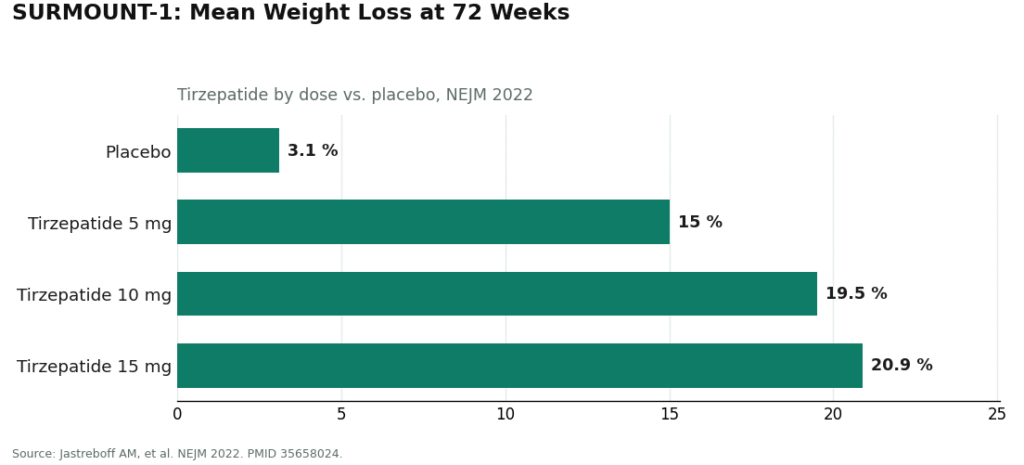
Every “tirzepatide wins” argument eventually cites the same figure, so I traced it back. It comes from SURMOUNT-1, the tirzepatide obesity trial published in the New England Journal of Medicine: mean weight loss around 15.0% at 5 mg, 19.5% at 10 mg, and 20.9% at 15 mg over 72 weeks, against about 3.1% on placebo [P1]. That’s a real, solid, randomized-trial result. Nobody’s disputing it.
Here’s the part that gets dropped on the way to the group chat: that number came from a trial of tirzepatide, against placebo, in a specific population, with lifestyle counseling built in, at doses people worked up to gradually. It is not a number generated by putting semaglutide patients in the room next to them and timing a race. Nobody ran that race. Cross-trial comparisons, different populations, different protocols, get flattened into a single leaderboard graphic and presented as settled fact, and that’s where I stopped trusting the argument. I’m not going to hand you a semaglutide percentage to sit next to 20.9% and pretend that’s a head-to-head, because it isn’t one, and anyone doing that to you is selling you certainty the data doesn’t have.
The question nobody in the comment section is asking
If “which is better” is the wrong question, what’s the right one? Based on what’s actually in the label and the trial literature, it’s something closer to: which drug fits your history, how do you tolerate one versus the other, and can you actually get it and stay on it. None of that shows up on a bar chart.
That’s not a dodge. It’s because both drugs sit inside the same safety architecture, and the fit matters more than the potency. Tirzepatide carries the FDA’s most serious designation, a boxed warning, for thyroid C-cell tumors, and it’s contraindicated for anyone with a personal or family history of medullary thyroid carcinoma or MEN 2 [P2]. The whole class shares GI side effects that show up hardest during dose increases [P2]. None of that gets resolved by picking the drug with the bigger number in its own trial. It gets resolved by someone asking you questions about your own history, which a listicle cannot do.
The uncomfortable part
Here’s where the investigation actually got interesting, because the real risk gap isn’t between the two drugs. It’s between two people taking the exact same drug.
Picture two people on chemically identical tirzepatide. One got screened by a clinician, checked against that thyroid contraindication, walked through the interactions, and started on a slow-climbing dose schedule. The other clicked through a no-questions-asked site and got a vial in the mail. Same molecule. Not the same risk. The contraindication is a question a form has to ask you, and a checkout page has never once asked anybody a question in its life [P2].
There’s a second thing buried in the label that almost never makes it into the “tirzepatide vs semaglutide” debates: tirzepatide can reduce how well oral contraceptives work, and the label recommends a barrier method or a non-oral method for four weeks after starting and after every dose increase [P2]. I went looking for who tells patients this. The answer, mostly, is nobody, unless a clinician is actually in the room. A cart total doesn’t mention it either.
So the fight everyone’s having, dual receptor versus single receptor, 20.9% versus some semaglutide number nobody should be quoting, is the wrong fight. The comparison that actually changes your odds is screened versus unscreened. That’s not a hedge I’m adding for flavor. That’s what the record shows.
The supervised path, named once
If you want the screen, here’s what it looks like on paper: a licensed clinician who actually checks you against the contraindications, a real prescription issued because it fits your case, and a licensed pharmacy filling it with follow-up attached. FormBlends is a telehealth provider built on that structure, and because it offers the drug class rather than pushing one molecule, it’s set up to help you answer the “which drug fits me” question rather than sell you a predetermined answer. That’s a description of what supervision looks like, not an endorsement of a purchase, because there’s nothing here for sale.
The verdict
Both drugs are real, FDA-approved, and backed by actual trials, no scam on either side [P1] [P3] [P4]. The one genuine difference is the extra receptor tirzepatide engages, which is a real reason it’s often called the more potent option [P3] [P4]. The 15.0% to 20.9% figure from SURMOUNT-1 is a legitimate number, but it’s a trial average, not a promise with your name on it [P1].
What actually decides your outcome isn’t which of these two drugs you pick. It’s whether anyone asked you the thyroid question before you started either one [P2]. Get the right drug for you, with someone qualified helping you choose, inside a structure that actually checks your history, and the “which is better” argument stops being the thing that matters. You’ll just be on the one that’s better for you, which was the only honest answer this whole time.
Questions worth answering
Is tirzepatide actually stronger than semaglutide? It activates two incretin receptors, GIP and GLP-1, where semaglutide activates one [P3] [P4]. That’s a real mechanical edge, and it’s why SURMOUNT-1 posted mean weight loss around 15.0% to 20.9% across doses over 72 weeks [P1]. But “stronger in its own trial” is a population average. It isn’t a personal guarantee that you specifically will lose more on it than you would have on the other drug.
Can I just line up the weight-loss percentages from each drug’s trial and call it a comparison? No, and I’d be skeptical of anyone who does. Different trials, different populations, different protocols, different dosing schedules. Stacking two numbers from two separate studies and calling it a head-to-head is a shortcut that skips the actual work. Only a real direct comparison trial settles that question, and this isn’t one.
Who shouldn’t be anywhere near tirzepatide? Anyone with a personal or family history of medullary thyroid carcinoma or MEN 2. That’s the FDA’s most serious warning tier, a boxed warning, tied to thyroid C-cell tumor risk [P2]. It’s also exactly the kind of history that only comes out if someone actually asks you about it before your first dose.
Does tirzepatide mess with birth control? Yes. The label says it can reduce how well oral hormonal contraceptives work, and recommends a barrier method or a non-oral method for four weeks after starting and after each dose increase [P2]. It’s the sort of detail a clinician flags in a conversation and a checkout page simply never brings up.
Why do the side effects look so similar between the two drugs? Because most of the underlying biology overlaps. Both slow gastric emptying, boost glucose-dependent insulin release, and cut appetite, so the common complaints, mostly gastrointestinal, show up in both, especially while doses are being increased [P2] [P3] [P4]. Tirzepatide just gets there through an extra pathway.
If both drugs are FDA-approved, why does it matter where I actually get them? Because “FDA-approved” describes the molecule, not your particular experience with it. Two people can take the identical compound and carry very different risk depending on whether anyone checked them against the thyroid contraindication or walked them through the interactions first [P2]. The screening is what turns an approved drug into a safely used one.
References
- Jastreboff AM, et al. Tirzepatide Once Weekly for the Treatment of Obesity. New England Journal of Medicine, 2022. PMID 35658024. Mean weight change at 72 weeks roughly 15.0% (5 mg), 19.5% (10 mg), and 20.9% (15 mg) versus 3.1% placebo, treatment-regimen estimand. https://www.nejm.org/doi/full/10.1056/NEJMoa2206038
- Tirzepatide (Zepbound) FDA-approved label, DailyMed. Boxed warning for thyroid C-cell tumors; contraindicated with personal or family history of medullary thyroid carcinoma or MEN 2; oral hormonal contraceptive interaction with advice to add a barrier method or switch to a non-oral method for 4 weeks; most common adverse reactions are gastrointestinal, most noticeable during dose escalation. https://dailymed.nlm.nih.gov/dailymed/drugInfo.cfm?setid=487cd7e7-434c-4925-99fa-aa80b1cc776b
- Farzam K, Patel P. Tirzepatide. StatPearls, NCBI Bookshelf. Dual GIP and GLP-1 receptor agonist, 39-amino-acid GIP analog; increases glucose-dependent insulin secretion, slows gastric emptying, reduces appetite.
- Collins L, Costello RA. Glucagon-Like Peptide-1 Receptor Agonists. StatPearls, NCBI Bookshelf. GLP-1 receptor agonist class mechanism: glucose-dependent insulin secretion, slowed gastric emptying, appetite reduction (single-receptor class context for semaglutide).