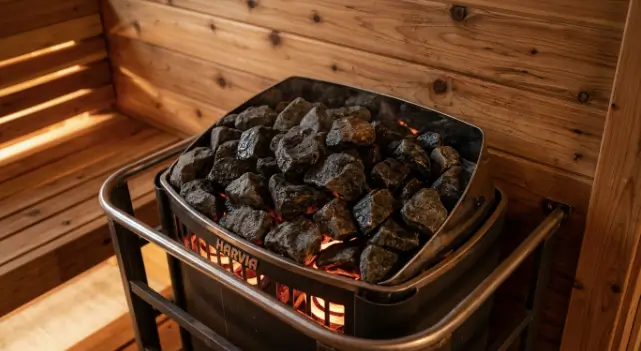
Electric sauna heater sizing is based on cubic footage, not square footage: a rough starting point is one kilowatt of heater output for every 45 to 60 cubic feet of well-insulated cabin space. A two-person cabin around 150 cubic feet typically needs 4.5 to 6 kilowatts, a four-person cabin around 280 cubic feet needs roughly 6 to 7.5 kilowatts, and a six-person cabin near 400 cubic feet needs 8 to 9 kilowatts. Ceiling height, glass area, and insulation quality all shift these numbers, which is why the questions below matter more than a single rule of thumb.
How Do I Calculate the Cubic Footage of My Sauna Space?
Multiply interior length by width by height, all in feet, using the finished interior dimensions rather than the kit’s exterior footprint. A cabin measuring 6 feet by 6 feet with a 6.5 foot ceiling works out to 234 cubic feet. This number, not the floor square footage, is what heater sizing charts are built around, since a taller room holds more air volume to heat even with an identical footprint.
What Kilowatt Heater Do I Need for a Two-Person Cabin?
Most two-person cabins fall between 100 and 170 cubic feet, which typically calls for a 4.5 to 6 kilowatt heater. The lower end of that range suits a tightly sealed, well-insulated cabin with minimal glass, while the higher end fits a cabin with a glass door or slightly larger footprint. Manufacturer sizing charts are the best final word here, since insulation quality varies enough between kit brands that a rule of thumb alone can be off by half a kilowatt in either direction.
What About a Four- or Six-Person Cabin?
A four-person cabin, generally 250 to 340 cubic feet, usually needs 6 to 7.5 kilowatts. A six-person cabin, often 400 cubic feet or more, typically needs 8 to 9 kilowatts and frequently steps up to a three-phase or higher-amperage circuit depending on local electrical code. Larger cabins also more often need a contactor box as a switching component between the breaker and heater, which is worth budgeting for at this size rather than assuming a simple direct wire connection will suffice.
Does a High Ceiling Change the Heater Size I Need?
Yes, directly. A cabin with a 7 foot ceiling holds noticeably more air volume than the same footprint with a 6.5 foot ceiling, and that extra volume has to be heated regardless of floor space. Garage installations run into this often, since a garage might have 8 feet of clear height that goes unused as sauna space but still needs to be factored in if the cabin is built to that full height rather than framed down with a dropped ceiling.
What If My Cabin Has a Lot of Glass or an Uninsulated Wall?
Glass loses heat much faster than a solid wood panel, so a cabin with a full glass door, a large window, or a glass wall section typically needs a heater one size up from what a solid-wall cubic footage calculation alone would suggest. The same applies to any wall backing onto an uninsulated exterior space, like an unheated garage in a cold climate, where heat loss through that wall runs higher than the sizing chart assumes for a standard interior installation.
Can I Oversize the Heater to Heat Up Faster?
It is tempting, but oversizing has real downsides. A heater rated well above what the cubic footage calls for cycles on and off more than a correctly sized unit running closer to steady output, which can produce less stable temperature and humidity through a session. It also costs more to buy and, in many cases, needs a higher-amperage circuit than a properly sized heater would require, adding to installation cost without a real benefit. A heater matched closely to the room’s actual volume, checked against manufacturer sizing charts across brands like the ones carried by Sweat Decks, generally delivers a more consistent session than an oversized one running below its rated capacity most of the time.
What Voltage Do I Need Once I Know the Kilowatt Size?
Heaters above roughly 6 kilowatts almost always need a dedicated 240-volt circuit with its own breaker sized to the heater’s amperage draw. Smaller units under about 2 kilowatts can sometimes run on a standard 120-volt household outlet, which simplifies installation but limits the heater to a very small cabin. Confirm both the voltage and the amperage draw against the heater’s nameplate spec before an electrician runs the circuit, since guessing at amperage based on kilowatt rating alone can result in an undersized breaker.
Should I Round Up or Down If My Cabin Falls Between Two Sizes?
When the cubic footage calculation lands between two heater sizes on a manufacturer’s chart, the deciding factors are climate and insulation quality rather than a fixed rule. A cabin in a cold garage or an unheated outdoor location with average insulation is usually better served rounding up, since the heater has to fight more ambient heat loss than a tightly sealed indoor cabin in a temperate climate. A well-insulated indoor cabin with a solid door and minimal glass can often round down without trouble, since it holds heat more efficiently once it reaches temperature. If in doubt, most manufacturer support lines will review a cabin’s exact dimensions and materials and recommend a specific model rather than leaving buyers to guess between two options on a general chart.
What’s the Difference Between a Residential and Commercial-Rated Heater?
Commercial-rated heaters are built for higher duty cycles, meaning they are designed to run near-continuously across long open hours at a gym or spa, and they typically carry heavier-gauge components and higher amperage requirements to match. Residential heaters are built around the intermittent use pattern of a household, a handful of sessions a week rather than daily all-day operation, and cost significantly less as a result. Installing a commercial-rated heater in a home is not wrong, but it is usually unnecessary expense for a household use pattern, while installing a residential-rated heater in a facility with heavy daily use would wear it out faster than its duty cycle is designed for. Match the heater’s rated duty cycle to actual expected use rather than defaulting to the more expensive option assuming it is automatically better.
Frequently Asked Questions
What happens if a sauna heater is undersized? It runs constantly trying to reach target temperature and often falls short, especially on cold days, which shortens the heating element’s life and weakens the session.
Can a sauna heater be too big for the room? Yes. An oversized heater cycles more than necessary, can produce less stable temperature and humidity, and costs more without added benefit.
How do I measure cubic footage for heater sizing? Multiply interior length by width by height in feet, using actual interior dimensions rather than the kit’s exterior footprint.
Do glass doors or windows change the heater size I need? Yes. Glass loses heat faster than solid wood, so a cabin with a large glass area typically needs a heater one size up.
References
- Cardiovascular and Other Health Benefits of Sauna Bathing: A Review of the Evidence, Mayo Clinic Proceedings, 2018
- Clinical Effects of Regular Dry Sauna Bathing: A Systematic Review, Evidence-Based Complementary and Alternative Medicine, 2018
- Effects of heat and cold on health, with special reference to Finnish sauna bathing, American Journal of Physiology, 2018
By Renee Okafor